The business that generates $50,000/month in revenue and $12,000 in gross profit can still run out of cash in 90 days. This is not a hypothetical. It is the most common failure mode for eCommerce businesses between $30K and $80K in monthly revenue — and the math behind it is straightforward once you see it.
The problem is not profitability. The problem is timing. Cash leaves your account weeks or months before it comes back, and the faster you grow, the wider that gap becomes.
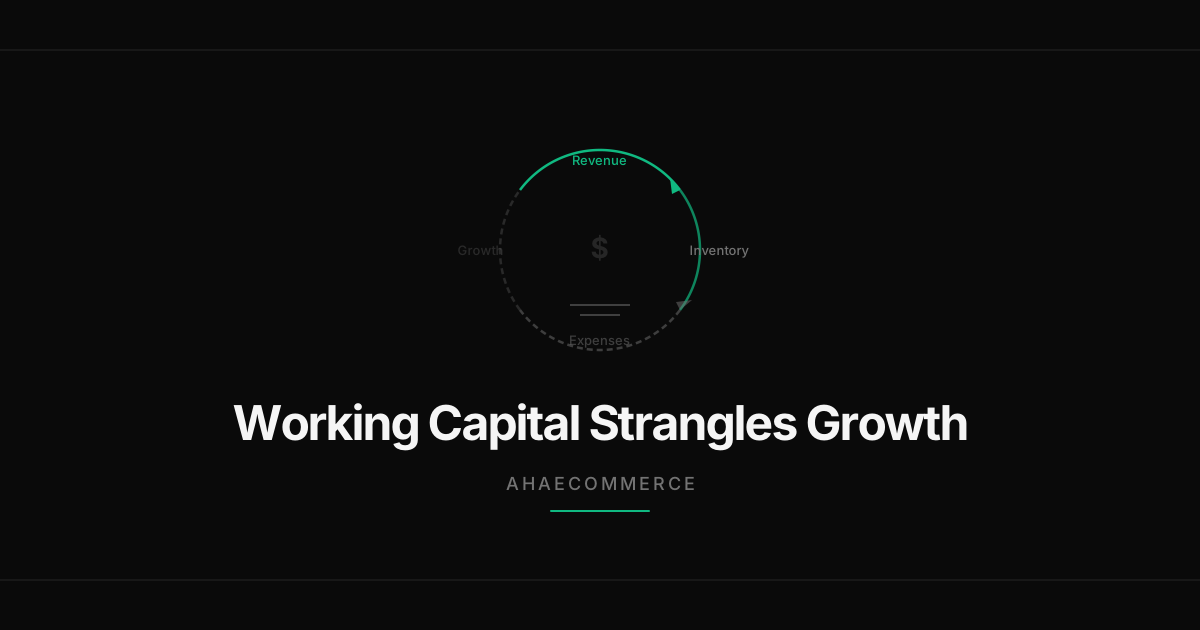
Working capital is not a finance problem. It is a physics problem. Cash has mass, and the velocity at which it moves through your business determines whether growth feeds itself or starves itself.
The Cash Conversion Cycle
Three metrics define whether your business generates cash or consumes it:
Days Inventory Outstanding (DIO): How many days inventory sits in your warehouse before it sells. For most eCommerce businesses at $50K/month, this is 45–90 days.
Days Sales Outstanding (DSO): How many days between making a sale and receiving payment. For DTC with credit card processing, this is 2–5 days. For wholesale/B2B channels, 30–60 days.
Days Payable Outstanding (DPO): How many days you have before you must pay your suppliers. Net 30 terms give you 30 days. Prepayment terms give you zero.
Cash Conversion Cycle = DIO + DSO − DPO
Here is what that looks like for a real $50K/month business:
| Scenario | DIO | DSO | DPO | Cash Conversion Cycle |
|---|---|---|---|---|
| Best case (DTC, net 60 terms) | 45 days | 3 days | 60 days | −12 days (cash positive) |
| Typical case (DTC, net 30 terms) | 60 days | 3 days | 30 days | 33 days (cash gap) |
| Worst case (mixed channels, prepay suppliers) | 75 days | 15 days | 0 days | 90 days (cash crisis) |
A 33-day cash conversion cycle at $50K/month means you need roughly $55,000 in working capital just to keep operating at current scale — before any growth investment. At a 90-day cycle, that number exceeds $150,000.
Most operators at this revenue level have $20,000–$40,000 in available cash. The math does not work, and it gets worse the faster you grow.
The Three Working Capital Traps
Trap 1: The Inventory Pre-Purchase Cycle
You buy inventory 60–90 days before you sell it. For manufactured goods with overseas suppliers, the timeline is longer: 30 days for production, 30 days for shipping, 15 days for customs and receiving, then 45–60 days of warehouse time before the average unit sells.
That is 120–135 days from cash out to cash in.
| Timeline | Cash Event | Cumulative Cash Impact |
|---|---|---|
| Day 0 | Place PO for $28,000 of inventory (50% deposit) | −$14,000 |
| Day 30 | Production complete, pay remaining 50% | −$28,000 |
| Day 60 | Goods arrive, pay freight + duties ($3,200) | −$31,200 |
| Day 75 | First units begin selling (~$800/day revenue) | −$25,600 |
| Day 105 | 50% of order sold | −$11,600 |
| Day 135 | 80% of order sold (20% slow-moving) | −$200 |
| Day 150+ | Remaining 20% sells at discount or sits | Break-even or small loss |
The critical insight: you placed your next purchase order on Day 75 because lead times require it. That is a second $28,000 cash outflow before the first order has recovered its cost. This is how profitable businesses run out of cash.
Trap 2: The Growth Acceleration Trap
Growing 20% month-over-month sounds healthy. The working capital math tells a different story.
If you sell $50,000 in March and plan to sell $60,000 in April, you need to purchase $60,000 worth of inventory (at cost, roughly $18,000–$21,000 depending on margins) before April revenue arrives. But March's cash has not fully collected yet — it is still cycling through the conversion cycle.
| Month | Revenue | Inventory Needed (at cost) | Cash Available from Prior Month | Cash Gap |
|---|---|---|---|---|
| Month 1 | $50,000 | $15,000 | $12,000 (from Month −1 sales) | −$3,000 |
| Month 2 | $60,000 | $18,000 | $14,000 | −$4,000 |
| Month 3 | $72,000 | $21,600 | $16,800 | −$4,800 |
| Month 4 | $86,400 | $25,920 | $20,160 | −$5,760 |
| Month 5 | $103,680 | $31,100 | $24,192 | −$6,908 |
Each month, the gap widens. By Month 5, you have accumulated a $24,468 cash deficit — despite a business that nearly doubled in revenue. Every dollar of growth requires more than a dollar of working capital to fund it.
Trap 3: The Seasonal Inventory Trap
Seasonal businesses face an amplified version of the same problem. If 40% of your annual revenue comes in November and December, you need to purchase that inventory in August and September — three months before the cash arrives.
For a $50K/month business that does $120,000 in each holiday month, the math looks like this:
- August–September inventory purchase: $72,000 (at cost, for $240,000 in holiday revenue)
- August–September revenue: $50,000/month = $100,000
- August–September gross profit: $24,000
- Net cash position entering October: −$48,000 relative to normal operations
You need $48,000 in additional working capital above your normal operating needs, concentrated in a 60-day window. Most businesses at this scale do not have that reserve.
Five Levers to Manage Working Capital
1. Negotiate Supplier Payment Terms
Moving from net 30 to net 60 terms on a $28,000 purchase order gives you 30 additional days with that cash. At $50K/month revenue, this single change reduces your cash conversion cycle by 30 days and frees up approximately $50,000 in working capital annually.
The trade-off: suppliers who offer extended terms often price it in. Net 60 terms may cost 2–3% more than net 30, and 5–8% more than prepayment pricing. On $28,000, that is $560–$840 per order — effectively a financing cost of 11–17% annualized.
2. Reduce Inventory Days
Cutting DIO from 75 days to 45 days at $50K/month frees up roughly $25,000 in cash. But there is a real trade-off.
Just-in-time ordering means smaller, more frequent orders. You save on warehouse costs and reduce dead stock risk. You lose volume discounts (typically 8–15% on larger orders) and increase per-unit freight costs.
The math at $50K/month revenue:
- Bulk ordering (quarterly): $15,000 per order, 8% discount = $1,200 saved per quarter
- JIT ordering (monthly): $5,000 per order, no discount, +$400/month freight premium
- Net cost of JIT: ~$2,800/year more in product cost
- Cash freed by JIT: ~$25,000
If your cost of capital exceeds 11% (which it does for most businesses using credit cards or revenue-based financing), JIT ordering wins despite the higher product cost.
3. Improve Cash Collection Speed
For DTC businesses, payment processing is already fast — 2–5 days with Stripe or Shopify Payments. The lever here is smaller than it appears unless you sell through wholesale or marketplace channels.
Where this matters:
- B2B/wholesale channels paying on net 30–60: Consider offering 2/10 net 30 terms (2% discount for payment within 10 days). On $10,000 invoices, you lose $200 but collect 20 days faster.
- Subscription pre-billing: Collecting payment at the start of a subscription cycle rather than at fulfillment can shift DSO from 15–30 days to negative. You receive cash before you incur the cost.
- Payment processor selection: Some processors hold funds for 7–14 days for new merchants. Switching to a processor with 2-day payouts reclaims 5–12 days of cash.
4. Revenue-Based Financing
Revenue-based financing (RBF) advances cash against future revenue, typically 1–2x monthly revenue, repaid as a percentage of daily sales (usually 10–20%).
When it makes sense:
- You have a proven product with consistent monthly revenue
- The cash will fund inventory that sells within 60–90 days
- Your gross margin exceeds 40%
- The total repayment cost is under 15% annualized
When it is a trap:
- You are using it to cover operating expenses, not inventory
- Your gross margin is under 35% — the financing cost eats most of your profit
- You are stacking multiple advances (total repayment exceeding 20% of revenue)
- The cash funds inventory with uncertain sell-through (new products, untested SKUs)
| Financing Method | Typical Cost (annualized) | Speed | Best For |
|---|---|---|---|
| Revenue-based financing | 15–35% | 2–5 days | Proven inventory with fast sell-through |
| Business line of credit | 8–18% | 1–3 weeks (setup), instant (draws) | Seasonal cash gaps with predictable repayment |
| Supplier financing (extended terms) | 11–17% (implicit) | Immediate | Ongoing supplier relationships |
| Credit cards | 20–28% | Immediate | Emergency only — never for planned inventory |
| SBA microloan | 6–13% | 30–90 days | Established businesses with 2+ years history |
5. Pre-Order and Deposit Models
Pre-orders flip the cash conversion cycle. Customers pay before you purchase inventory, making your DPO effectively infinite for those units.
The trade-off is real: customers expect discounts (typically 10–20%) for pre-orders, and you carry fulfillment risk. If the product ships late or the final version differs from the listing, returns and chargebacks spike.
Pre-orders work best when:
- You have an established product with a proven audience
- Lead times are 30–60 days (short enough that customers wait)
- You offer meaningful value (early access, limited edition, 15% discount)
- You communicate shipping timelines clearly and update proactively
At $50K/month, converting 20% of revenue to pre-orders frees up roughly $10,000–$15,000 in working capital per month — enough to meaningfully change your cash position.
The Decision Framework: Finance Growth or Slow Down
This is the decision most operators avoid until cash forces it. Here is how to evaluate it.
| Factor | Finance Growth | Slow Growth |
|---|---|---|
| Gross margin | Above 45% — financing cost is absorbable | Below 35% — financing eats your margin |
| Product-market fit | Proven demand, repeat customers, <5% return rate | Unproven demand, first-year product, >10% return rate |
| Cash conversion cycle | Under 45 days — cash recycles quickly | Over 75 days — financing compounds the problem |
| Growth rate | 15–25%/month — sustainable acceleration | Over 30%/month — likely unsustainable regardless |
| Revenue concentration | Diversified channels, no single customer >15% | Single channel or seasonal dependency >40% |
| Inventory sell-through | Over 80% at full price within 60 days | Under 60% at full price, frequent markdowns |
The harder decision is choosing to slow growth deliberately. Operators resist this because it feels like failure. It is not. Growing at 10% per month instead of 25% while building cash reserves is how businesses survive to reach $100K/month instead of flaming out at $65K.
The math on deliberate slowdown:
- At 25% growth from $50K, you reach $150K/month in 5 months — but need $90K+ in working capital to get there
- At 10% growth from $50K, you reach $80K/month in 5 months — but need only $25K in additional working capital
- The slower path builds $40K–$60K in cash reserves that fund the next acceleration phase from a position of strength
What This Means for Your Business
Working capital is not a problem you solve once. It is a constraint you manage continuously. The cash conversion cycle changes with every new supplier, every new sales channel, every seasonal shift.
Three actions to take this week:
-
Calculate your actual cash conversion cycle. Pull your last three purchase orders. Note the date you paid, the date the first unit sold, and the date the last unit sold. That is your DIO. Add your DSO and subtract your DPO. If the number is above 60, you have a working capital problem — even if you are profitable.
-
Model the next 90 days of cash flow. Not revenue — cash. When does cash leave (POs, rent, payroll, marketing spend) and when does it arrive (net of processing holds and refunds)? If any week shows negative cash, that is the week your business stalls.
-
Pick one lever. Do not try to fix everything simultaneously. If your DIO is over 60 days, focus on inventory velocity. If your DPO is under 30 days, negotiate terms. If you are growing over 20% monthly, model whether you can sustain the cash requirement.
The businesses that survive the $50K–$80K working capital squeeze are not the ones with the best products or the highest margins. They are the ones that managed cash timing before the timing managed them.
What to Read Next
- The Inventory-Cash Flow Trap at $50K/Month — Deep dive into inventory-specific cash traps and three frameworks for managing through them.
- The Break-Even Analysis Nobody Does — The full cost structure mapping that reveals your true break-even point, including the four cost categories most operators miss.