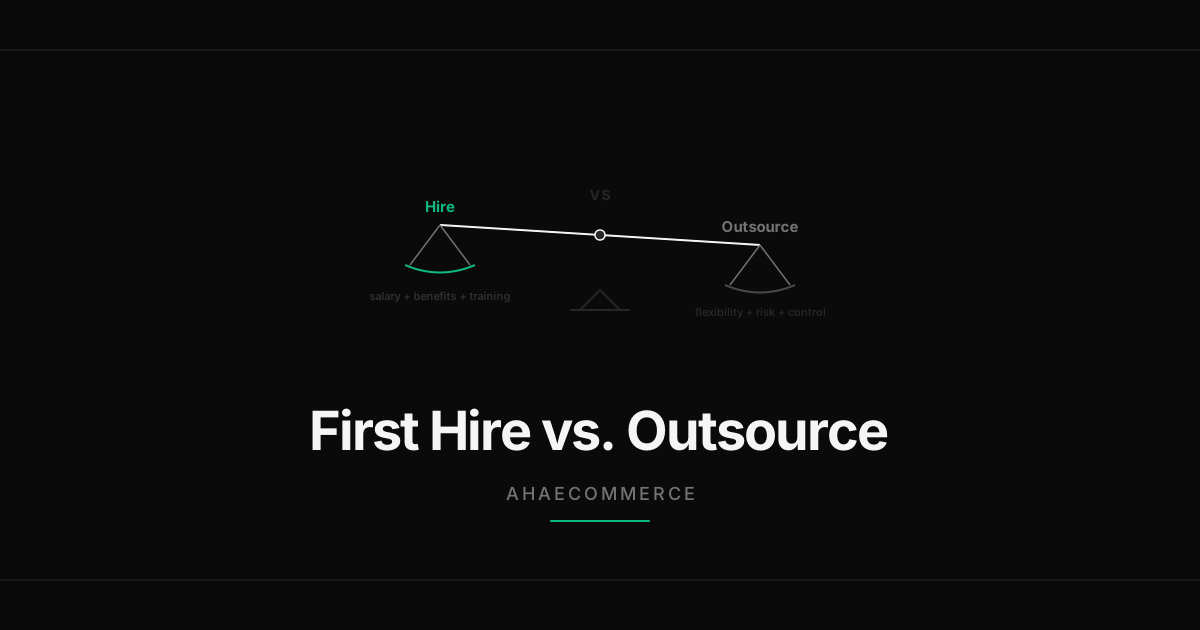
Your first full-time hire costs $55,000–$75,000 per year fully loaded — not the $40,000 salary on the job listing. The outsourced equivalent costs $24,000–$36,000 per year. But after 18 months, the full-time hire is almost always cheaper. The question is whether your business survives the first 18 months of higher costs.
This is the highest-leverage personnel decision in a growing eCommerce business. Get it right, and you buy back 20–30 hours per week to focus on growth. Get it wrong, and you spend six months managing a mistake that costs more to unwind than it cost to make.
Most operators frame the first hire decision as "who should I hire?" The better question is "should I hire at all right now?" The answer depends on what you're actually spending your time on, whether that work builds institutional knowledge, and whether the volume justifies a full-time salary. More than half of first hires in sub-$500K eCommerce businesses are the wrong role at the wrong time.
The True Cost Comparison
The salary number on a job listing is the beginning of the cost, not the total. Operators who compare a $40,000 salary to a $2,000/month freelancer are comparing the wrong numbers.
Full-Time Hire: The Fully Loaded Multiplier
The standard fully loaded multiplier for a full-time employee is 1.3–1.5x base salary. For a $40,000 hire, that means $52,000–$60,000 in actual annual cost. For a $50,000 hire, $65,000–$75,000.
| Cost Category | Typical Range | Notes |
|---|---|---|
| Base salary | $35,000–$55,000 | Entry-level operations, customer service, or marketing coordinator roles in eCommerce |
| Benefits (health, PTO, retirement) | $4,500–$11,000/year | Even minimal benefits add 10–20% to base salary |
| Payroll taxes (FICA, unemployment) | $3,000–$5,500/year | 7.65% FICA + state unemployment insurance — non-negotiable |
| Equipment and software | $1,500–$3,000 upfront | Laptop, monitors, software licenses, workspace setup |
| Training and ramp-up | $2,000–$5,000 equivalent | 2–4 months at reduced productivity. Founder time spent training. |
| Management overhead | $5,000–$15,000/year | 4–8 hours/week of founder time at $50–$100/hour equivalent |
| Downtime between tasks | 5–15% of work hours | Full-time employees have gaps between projects. You pay for 40 hours regardless. |
The management overhead line is the one most operators miss entirely. Someone has to set priorities, review work, give feedback, handle questions, and cover during PTO. For a solo founder making the first hire, that someone is you — and those 4–8 hours per week are hours you're not spending on revenue-generating work.
Outsourced or Freelance: The Hidden Costs
Outsourcing looks cheaper on paper because you only pay for hours worked. The hidden costs are slower to appear but just as real.
| Cost Category | Typical Range | Notes |
|---|---|---|
| Hourly or project rate | $25–$75/hour (freelance), $2,000–$5,000/month (agency) | Specialist freelancers command higher rates but deliver faster |
| Management and communication | 3–6 hours/week | Briefing, reviewing, providing feedback, managing timelines — this time adds up |
| Quality inconsistency | Variable | No two deliverables are the same quality. Revision cycles cost time. |
| Context rebuilding | 15–30 min per engagement | Every new task requires re-explaining your business, brand, and standards |
| No institutional knowledge | Ongoing cost | The freelancer leaves and takes all the context with them |
| Dependency risk (agency) | High | If the agency raises rates or closes, you start from zero |
Agency: The Third Option Nobody Budgets Correctly
Agencies sit between freelancers and full-time hires in cost, but they introduce their own risks. A marketing agency retainer runs $3,000–$8,000 per month ($36,000–$96,000 per year). At the high end, that exceeds a full-time hire — and you own none of the institutional knowledge.
The agency model works when you need specialized expertise for a defined period: launching paid ads, redesigning your site, building a custom integration. It fails when used as a permanent substitute for building internal capability. Every month on an agency retainer is a month you're not developing the skills and systems inside your business.
The Four Wrong First Hires
These are the four most common first hires in growing eCommerce businesses — and three of them are wrong.
Wrong: Marketing Manager Before Operations Are Stable
This is the most tempting and most destructive first hire. Revenue is growing, you want to accelerate it, and a marketing hire feels like pouring fuel on the fire.
The problem: marketing drives demand. If your fulfillment process breaks at 50 orders/day and marketing pushes you to 100, you don't get double the revenue. You get double the customer complaints, doubled return rates, and a reputation problem that takes months to recover from.
Wrong: Virtual Assistant When You Need a Specialist
A virtual assistant at $8–$15/hour looks like a bargain compared to a $50,000 specialist. The math checks out on paper: you're paying $16,000–$30,000/year instead of $50,000+.
But a generalist VA cannot do specialist work. They can't write product descriptions that convert. They can't diagnose why your email open rates dropped. They can't negotiate with suppliers. They can't troubleshoot a broken Shopify workflow. You hire them to save money, then spend your own time doing the specialist work anyway — plus the additional time managing the VA.
The VA hire is right when the work is genuinely administrative: data entry, order processing, customer inquiry triage, scheduling. It's wrong when you're using "VA" as a euphemism for "cheap specialist."
Wrong: Technical Hire When the Product Isn't Proven
A developer or technical hire at $60,000–$120,000 makes sense when you need custom functionality that off-the-shelf tools can't provide. It doesn't make sense when you're still figuring out what your product-market fit looks like.
Building custom before validating means you're spending $5,000–$10,000/month on development for features that might not matter. Use off-the-shelf tools to validate the concept. Hire the developer when the limitations of those tools become the bottleneck — not before.
Right: Operations or Customer Service When the Volume Demands It
The correct first hire for most eCommerce businesses in the $200K–$750K revenue range is operations (fulfillment, inventory, logistics) or customer service. These roles share three characteristics that make them the right first hire:
- The work is core and recurring — it happens every day, with every order
- Volume dictates the need — when fulfillment takes 4+ hours/day or support tickets exceed 2 hours/day, you've crossed the threshold
- Institutional knowledge compounds — an operations person who understands your fulfillment process, supplier quirks, and inventory patterns becomes more valuable every month
The Decision Framework
Before deciding hire vs. outsource, answer five questions about the specific function you're trying to fill.
Question 1: Is the work core or peripheral?
Core work directly affects your customer experience, product quality, or operational reliability. Fulfillment, customer service, product development, and inventory management are core. Peripheral work supports the business but doesn't define it: bookkeeping, graphic design for social media, one-time website updates, tax preparation.
Core work favors hiring. Peripheral work favors outsourcing.
Question 2: Is the workload recurring or project-based?
A task that happens every day at predictable volume is a hire candidate. A task that happens in bursts — a product launch, a seasonal campaign, a website redesign — is an outsource candidate.
Question 3: Does the work require deep context about your business?
Some work requires understanding your brand, customers, products, and systems at a level that takes months to develop. Other work can be briefed effectively in a one-page document.
Customer service that reflects your brand voice requires deep context. Logo design does not. Inventory management for products with complex supplier relationships requires deep context. Running a standard email marketing campaign does not.
Deep-context work favors hiring because the knowledge investment compounds. Shallow-context work favors outsourcing because the briefing cost is low.
Question 4: Does the volume justify the cost?
A full-time customer service hire at $40,000/year ($55,000 loaded) handles roughly 1,800 productive hours per year. If your support volume is 15 tickets/day at 15 minutes each, that's roughly 3.75 hours/day or 975 hours/year — the hire is operating at 54% capacity. The other 46% needs to be filled with additional responsibilities, or you're overpaying.
An outsourced customer service solution at $15–$25/ticket might cost $5,400–$9,000/year for the same 15 tickets/day. That's a fraction of the hire cost — until your volume hits 40+ tickets/day, at which point the per-ticket model becomes more expensive than the salary.
Question 5: Are you still figuring out what the role looks like?
If you can't write a clear job description with specific deliverables and success metrics, you're not ready to hire. You're still defining the role. Outsource to a freelancer first, learn what the work actually requires, then hire when you can describe the role precisely.
This is the question most operators skip, and it's the one that prevents the most expensive mistakes. Hiring for a role you haven't defined means the employee defines it — and their definition may not match your business needs.
The Outsourcing Trap: When Temporary Becomes Permanent
Outsourcing is the right starting point for most functions. The danger is when the "temporary" outsourcing arrangement becomes permanent without anyone making a conscious decision.
The pattern looks like this: you hire a freelancer for $2,000/month to handle a function. They do adequate work. Three months pass, then six, then twelve. The freelancer now costs $24,000/year, has no institutional knowledge, and you're still spending 3–5 hours per week managing them. The total cost — freelancer fee plus your management time — approaches what a full-time hire would cost, but without the compounding knowledge benefit.
Set a review trigger: if you've outsourced the same function for six continuous months and the volume is growing, run the five-question framework above. The answer has likely changed.
The Hybrid Approach: Outsource First, Hire Into the Role
The lowest-risk path for most growing eCommerce businesses combines both strategies in sequence.
Months 1–3: Outsource the function to a freelancer or specialist. This costs $6,000–$18,000 and teaches you exactly what the role requires, what skills matter, and how many hours the work actually takes.
Months 4–6: Evaluate. If the volume has grown, the work is core, and the freelancer relationship is becoming a management burden, start the hiring process. Use everything you learned from outsourcing to write a precise job description.
Months 7–9: Overlap period. The new hire learns from the freelancer during a 2–4 week handoff, then takes over fully. The freelancer transitions to an on-call resource for overflow or specialized projects.
This approach costs more in the short term — you're paying both the freelancer and the new hire during the overlap — but it dramatically reduces the risk of hiring the wrong person for the wrong role. The freelancer engagement serves as a live prototype for the position.
The Decision Point
The first hire decision isn't just a personnel choice — it's a capital allocation decision that shapes your business for the next two years. Hire too early in the wrong role, and you burn $55,000–$75,000 on a problem that didn't need a full-time solution. Outsource too long in a core function, and you build dependency without building capability.
Related Decisions
If you're thinking through your first hire, these two decisions are closely connected:
- When to Hire vs. Automate in eCommerce — Before you hire or outsource, make sure the work can't be automated entirely. The decision between a $55,000 hire and a $120/month tool is a different framework — and it should come first.
- Scaling Before Readiness: The $100K Mistake — Your first hire is a scaling decision. If your unit economics aren't ready for the additional fixed cost, hiring accelerates a cash problem instead of solving a capacity problem.